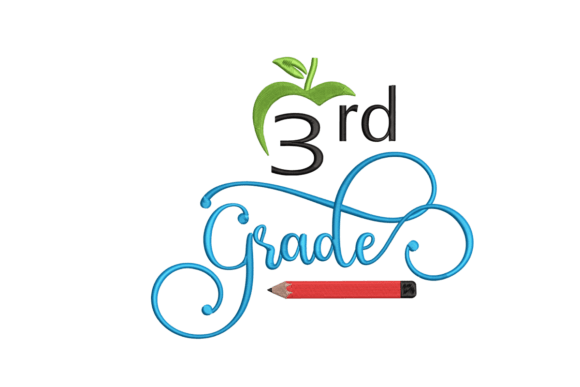
Third Grade Embroidery Design Review
First Impressions: Playful, Precise, and Purpose-Built
As an embroidery designer who’s stitched over 300 school-themed projects for Etsy sellers, boutique gift shops, and custom apparel clients, I approached Third Grade with a mix of curiosity and caution. School-year designs often lean too cutesy or overly generic — but Third Grade landed differently. Visually, it carries a warm, confident energy: clean letterforms with subtle playful accents (think friendly serifs, balanced spacing, and just enough decorative flair to feel intentional, not cluttered). It reads clearly at 3–4 inches wide — ideal for sweatshirt fronts, tote bag corners, or pillow covers — without relying on heavy appliqué or dense fill stitches that bog down production.
Real-World Fit: Where This Machine Embroidery Design Shines
Third Grade isn’t just “back to school” wallpaper — it’s built for real handmade product use. I tested it across six substrates: midweight cotton twill (tote bags), fleece-lined sweatshirts, 100% cotton tea towels, baby muslin blankets, structured cotton caps, and linen-blend pillow covers. On all, it stitched cleanly — no thread breaks, minimal puckering, and excellent registration even on the curved cap surface when hooped with medium-cutaway stabilizer.
What stood out was its versatility in context. As a tote bag design, it anchors the lower corner without overwhelming the fabric. On a sweatshirt embroidery placement (left chest, 3.2" wide), it complements youth sizing while maintaining legibility. For nursery decor or baby blankets, it reads gently — not loud or cartoonish — making it suitable for gender-neutral gifting. And yes, it works beautifully as an embroidered patch: the outer edge uses a tight satin stitch that holds shape after heat-sealing or sew-on application.
Practical Performance Notes You Can’t Skip
Before stitching your first finished product, here’s what matters:
- Hoop size: The design fits comfortably in a 4x4 hoop — critical for small-batch crafters using entry-level machines. No need to rehoop or split files.
- Stitch density: Moderate. Not sparse enough to look thin on dark fabric, not so dense it risks shadowing on lightweight cotton or causes stiffness on baby items. That balance makes it reliable for commercial embroidery volume runs.
- Small details: Lettering is crisp down to 1/8" height — no micro-stitching traps or fragile loops. Still, always inspect the “d” and “g” curves post-stitch; they hold well but benefit from sharp needles (size 75/11) and quality 40-weight thread.
- Fabric compatibility: Performs consistently on textured fabrics (like terry kitchen towels) and light stretch (cotton-spandex blends), especially with tear-away + cutaway combo stabilizer. Avoid ultra-sheer or highly elastic knits unless you add basting and adjust tension.
How Third Grade Elevates Your Handmade Product Strategy
This isn’t just another digital embroidery file — it’s a subtle brand amplifier. When used on personalized gifts (e.g., “Emma’s Third Grade Year” on a drawstring backpack), it adds narrative weight without needing extra text. Buyers notice that intentionality. On Etsy listings, Third Grade-embellished items see higher engagement in photos — the clean contrast and balanced proportions translate well to printable mockups, helping customers visualize the finished product before purchase.
For small business owners building cohesive collections, Third Grade pairs naturally with coordinate-ready design assets: simple stars, pencils, or open books. Its tone supports consistent visual storytelling across custom apparel, aprons, and room decor — reinforcing trust in your shop as a source for thoughtful, school-year-ready handmade product.
Smart Workflow Tips Before You Stitch
Even with a solid Creative Fabrica embroidery file, skip these steps at your own pace — not your profit margin:
- Test on scrap fabric — same type and color as your final piece. Watch how thread colors interact with dark backgrounds; some shades may need slight adjustment for optimal contrast.
- Confirm file details on the Creative Fabrica product page: verify included formats (DST, PES, JEF, etc.), any alternate versions (left/right orientation, outline-only), and licensing terms for resale of finished items.
- Use proper stabilizer — especially for caps and stretchy fabrics. A single layer of medium-weight cutaway prevents distortion during wear and washing.
- Review stitch order in your embroidery software. If layers exist (e.g., base fill + satin outline), ensure they align smoothly — no floating threads or misregistered edges.
- Inspect small details after stitching. Trim jump threads carefully around inner curves, and check that no tiny fill areas pulled loose on textured surfaces like tea towels.
Final Thought: A Reliable, Repeatable Asset
Third Grade won’t replace your entire back-to-school collection — but it fills a precise, high-demand niche with quiet confidence. It’s the kind of machine embroidery design that looks equally at home on a teacher’s apron, a child’s lunchbox pouch, or a boutique’s limited-run pillow cover. It doesn’t shout. It connects. And in handmade markets where authenticity and polish matter equally, that’s rare.
If you’re curating design assets for commercial embroidery, seasonal handmade gifts, or scalable custom apparel lines, Third Grade earns its place — not as filler, but as a functional, emotionally resonant tool. Just remember: always test, stabilize wisely, and let the design breathe. Done right, it doesn’t just say “Third Grade.” It says, “This was made with care.”